By MATTHEW
HODGES
Maumelle Monitor
August 30, 2000
While others spent last Wednesday night watching the finale of this summer's
TV smash "Survivor," another breed of survivors were training at Maumelle's
Bunker #3 along Lake Willastein.
Those Maumelle Volunteer Fire Department members used the break between
practicing rescue routines to check out a demo piece of equipment on loan
to their arsenal.
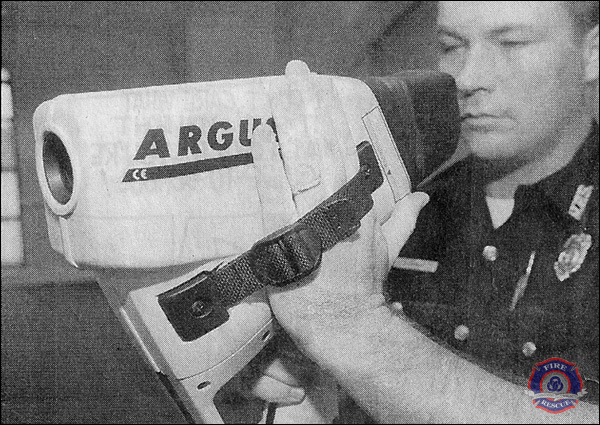
The Argus thermal imaging camera is not too large, weighing approximately
15 lbs. and roughly half the size of a small loaf of bread with a handle
on it. With a yellow mag shell, the camera is also durable, which is a plus
considering the abuse it may suffer in the line of duty.
And even though it will run on a few household batteries and is about as
user friendly as a flashlight, the camera also utilizes technology that is
complex enough to make it cost over $10,000.
But like the flames it helps fight, what you see isn't always what you
get.
"Fire is not like you see it in the movies, where lighting is necessary to
light up an actor's face," said Maumelle Fire Chief George Glenn. "It's dark,
funky stuff, and many times while crawling in on your hands and knees, you
don't know what's in front of you, not even being able to see your hand in
front of your face."
The thermal imaging camera is unique because it can see what the naked eye
cannot. In a room make to zero visibility by smoke, the infrared heat of
a victim's body will emanate to allow the camera's user to see them, barring
any obtrusive object such as a wall.
Such instant accuracy, Glenn said, will make saving lives that much more
efficient.
WHen searching for victims, he noted, time is of the essence.
"When fire occurs, people don't realize how fast it grows," Glenn said. "You're
literally talking about seconds, so when we arrive at the house, we want
to be able to search and locate people efficiently."
The camera can also be used to detect hidden fires where the hot spots are
concentrated but cannot be seen by the naked eye. It can also be used for
industrial purposes including chemical reactions and electrical wiring
mishaps.
It could even be used by the DPS to nab someone in the dark -- even if they
were fully camouflaged -- because heat sources would still be escaping from
their body.
Such capabilities have no escaped the notice of neighboring
programs.
North Little Rock's Fire Department Chief C.R. Vaughan said that his experience
with thermal imaging cameras has been positive and he hopes to purchase a
few when funds become available.
"We've looked at several different models and brands and we're looking real
heavy," he noted. "We'll be pushing for them at the first of the year. We
may be looking into even getting the first one by October."
Capt. Doug Coney of the Little Rock Fire Department had similar
praise.
"We love it. I wish we had the money to buy one for every man," he said.
"I don't know how we've managed without it."
But for all it's positives, there are strings attached -- being originally
used by the government, but now made available for civilian use, the technology
is not cheap.
The camera, which ranges in cost between $10,000 and $12,000, also has the
option of allowing a telemetry system for transmitting a visual signal to
a remote location. That addition, Glenn said, costs around $5,000 extra,
making the total package somewhere near $17,000.
Enter City Director Pam Skiles.
When Chief Glenn spoke at a Rotary meeting recently, he mentioned the fact
that Maumelle did not have such a camera. Upon hearing the need for a potential
life-saving device, Skiles brought an effort together on behalf of her real
estate firm and the Rotary Club to organized a drive of business and private
donors to collect the approximately $17,000 it will take to purchase such
a camera.
John Craft, a fellow Rotarian who was tapped to be the treasurer and accountant
for all of the drive's funds, said that the target date for raising the total
amount of money will be sometime in October.
The current total amount of pledges and orders is right around $2,800, Craft
said. |